World Bank Group course on Financing for Development

The Nairobo Outcome Document recognizes the role of local and regional governments in the achievement of the 2030 Agenda and commits to build their capacities and include them in consultations on development policy.
The 2nd High-Level Meeting of the Global Partnership for Effective Development Cooperation was held from the 29th of November to the 1st of December in Nairobi, Kenya

The pioneering new platform “Localizing the SDGs” will allow local governments to share knowledge on how to localize the 2030 Agenda for Sustainable Development. Local and regional governments now have a place to go to learn from one another about how best to achieve the SDGs in their communities: the online platform www.LocalizingTheSDGs.org, supported by the Global Taskforce, UNDP and UN-Habitat. The platform aims to provide practical direction in assessing, planning, implementing and monitoring local policies related to the SDGs, featuring tools to share experiences, discuss issues and ideas and post events and resources. The resources on the Localizing the SDGs platform will guide local and regional governments through each stage of SDGs implementation, including initializing the process; enabling institutional arrangements for SDGs implementation; development cooperation effectiveness; and capacity-building. The platform already includes a “Roadmap for the implementation and monitoring at subnational level of the SDGs”; the experience of the Government of Valencia, Spain in integrating the SDGs in its regional strategies and plans; a tool to collect data at the local level based on the Brazilian experience, and a guide developed by UNDP to support local governance in fragile and conflict affected settings. Discussion spaces allow users to exchange ideas and experiences, as well as to hold moderated discussions. Users can also suggest topics for future discussions, and upload and share their own experiences and tools. Background The Global Taskforce has long been actively engaged in debates on how to localize the 2030 Agenda, from our advocacy for the inclusion of an Urban SDG (what became SDG 11) to our proposals of localized targets and indicators for the Agenda. In the summer of 2014, the Global Taskforce co-led a consultation of local and regional governments on localization with UNDP and UN-Habitat (download the Localizing the Post-2015 Agenda consultation report) As part of this consultation, national dialogues were carried out in 13 countries, with approximately 4,200 participants from national and local institutions. There were also three global and six regional-level events, with more than 1000 participants from over 80 countries, and e-discussions on the World We Want platform. The process culminated in a global meeting in Turin, Italy, in October 2014, at which main outcomes of the consultation were presented and discussed (Turin Communiqué). The final consultation report concluded that local and regional governments have a critical role in setting priorities, executing plans, monitoring results and engaging with local businesses and communities, and that they will be essential to the achievement of the 2030 Agenda. More information:LocalizingtheSDGs.orgRoadmap for Localizing the SDGs: implementation and monitoring at subnational levelJoin the conversation on #LocalizingSDGs on TwitterLocalizing the Post-2015 Agenda consultation reportTurin Communiqué
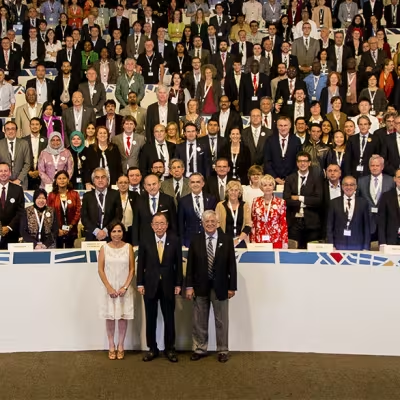
On 16th October 2016, on the eve of the Third UN Conference of Housing and Sustainable Urban Development (Habitat III), over a thousand representatives of local and regional governments gathered in Quito for the World Assembly of Local and Regional Governments to celebrate the adoption of the New Urban Agenda and to commit to play their part in its achievement.
 From Bogotá to Quito: local and regional governments celebrate the New Urban Agenda and call on UN Member States to #Listen2Cities at Habitat III
Local and regional governments are set to make a splash at Habitat III with the World Assembly of Local and Regional Governments, the Local and Regional Government Lounge, and a range of innovative side-events at this major global conference on housing and sustainable urban development in Quito.