Barcelona, 17 July 2026
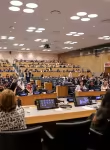
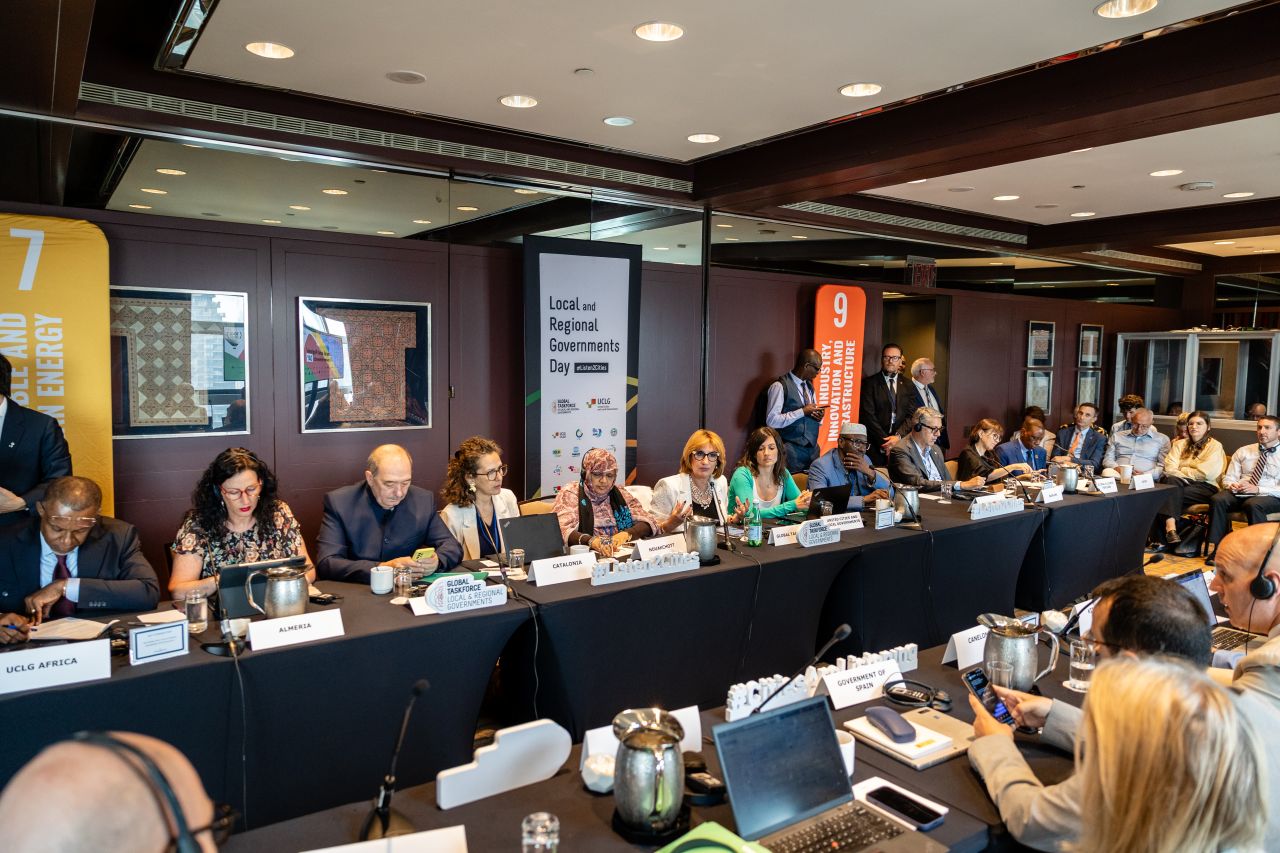
As the international community enters the final stretch of the 2030 Agenda, local and regional governments gathered during the 2026 High-Level Political Forum (HLPF, 7-16 July, New York) to reaffirm that achieving sustainable development will depend on empowering territories as spaces where global commitments become everyday realities.
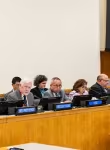
Convened by United Cities and Local Governments (UCLG) and the Global Taskforce of Local and Regional Governments (GTF), the Local and Regional Governments Day brought together mayors, governors, international organizations, UN agencies and civil society to discuss how local action can accelerate implementation while informing the debates that are starting to shape the international agenda beyond 2030.
The Day brought together over 15 local and regional leaders and elected officials from across the world, as well as local and regional government network members of the GTF including ICLEI, UCLG MEWA, UCLG ASPAC, CEMR-CCRE, UCLG Africa, UCLG Eurasia, Cités Unies France and the AIMF; allies such as the Congress of Local and Regional Authorities; partner organizations such as Habitat for Humanity International, the Global Alliance for Care, and Peace in our Cities Network; representatives of the UN, UNDESA and the UN Foundation, the UN Youth Office and the Local 2030 Coalition; and a number of representatives of national governments.
Ten years of localizing the SDGs: taking stock and looking ahead
Opening the day, the political tone was set by emphasizing the indispensable and unique role of local and regional governments in defending multilateralism and bringing global agendas closer to people's multifaceted, everyday realities.
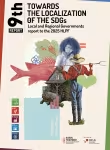
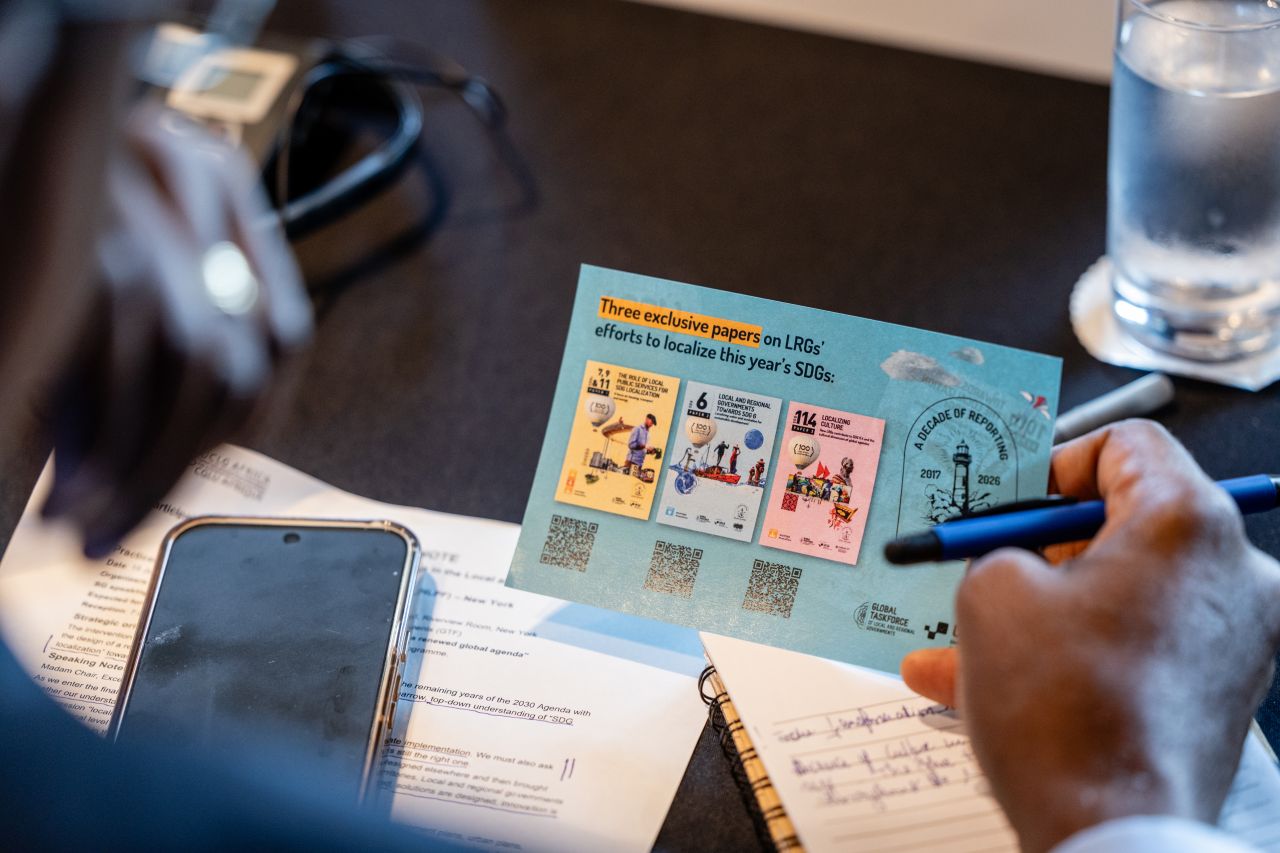
The first session marked the launch of the 10th edition of Towards the Localization of the Sustainable Development Goals, UCLG’s flagship report. This document has become the most comprehensive global assessment of how the local and regional level is contributing to the implementation of global agendas for development, including the New Urban Agenda, the 2030 Agenda and the SDGs.
Presented by members of the Global Taskforce, including UCLG Co-President and Mayor of Kitchener Berry Vrbanovic; Clare Hart, Vice President of Montpellier Méditerranée Métropole; Francisco Legnani, Mayor of Canelones; and Matthew Bach, Director of ICLEI Europe, the report offers both a reflection on progress achieved and a roadmap for the years ahead.
Participants explored the report's findings across its thematic papers, highlighting advances on SDGs 6, 7, 9, 11 and 17, as well as the growing contribution of culture as a driver of sustainable development. Throughout the discussion, participants stressed that reporting should not simply measure progress but strengthen trust between levels of government, improve accountability and help shape the emerging post-2030 global framework.
Universal local public services as the foundation of rights
The second panel focused on public services as the infrastructure of rights and sustainable development, emphasizing that quality public services are the most tangible expression of the SDGs in people's everyday lives.
Participants shared experiences demonstrating how local governments are expanding access to housing, water and sanitation, mobility, energy, care, culture, health, peace and digital connectivity while reducing territorial inequalities and strengthening social cohesion. Rather than treating these sectors independently, speakers presented them as interconnected foundations for dignity, equality, resilience and democratic trust.
The discussion also highlighted the conditions needed to scale these efforts, including stronger multilevel governance, predictable financing, innovation and partnerships that allow local governments to deliver universal access to essential services while responding to increasingly complex social and environmental challenges.
From the countdown to 2030 towards a renewed and inclusive global agenda
The closing dialogue looked beyond implementation to reflect on how local action should keep informing the next generation of global development frameworks and the political and actionable roadmaps that will accompany them.
Participants argued that the remaining years to 2030 must not be a simple countdown, but an opportunity to reinforce multilateralism by recognizing territories as spaces of democratic innovation, implementation and transformation. Across interventions, speakers called for preserving the ambition of the SDGs while ensuring that future international commitments are grounded in territorial realities and caring societies, human rights and universal access to essential public services.
The discussion also highlighted the importance of strengthening accountability across all levels of government and ensuring that local and regional governments are fully recognized as political partners in shaping the post-2030 agenda. Representatives from local government networks, the United Nations system, youth organizations and international partners stressed that renewed global governance will only succeed if it builds upon the experience cities and regions have accumulated over the past decade.
Local and regional governments are not simply implementing global agendas—they are actively shaping them. As we mark ten years of SDG localization and enter the final phase of the 2030 Agenda, the discussions reaffirmed that stronger multilevel governance, universal local public services and the meaningful participation of territories must remain at the heart of international cooperation.
The Local and Regional Governments Day emphasized the collective commitment of the Global Taskforce and its members to ensure that the voices, experience and political leadership of cities and regions continue to guide both the implementation of the SDGs and the design of the global agenda beyond 2030.
The LRG Day was organized back-to-back with the Local and Regional Governments Forum convened within the UN by the Global Taskforce as an official HLPF gathering on the day before. Launched as a key political space of the self-organized constituency of LRGs within the multilateral system, the LRGF convened a number of high-level local, regional and national representatives from cities and territories, as well as their partners. Through the LRGF, participants not only demonstrated the direct impact of local public service provision on communities and people’s daily lives, but also shared a critical perspective: coordinated, inclusive and multilevel territorial governance can only emerge through reinforced and resilient multilateralism.
Listening to cities to shape the future
Renewing multilateralism to advance the role of cities and territories in the post-2030 agendas
Additionally, several sessions and moments offered space for local and regional leaders to spread their messages and share their political ambition with the international community.
Ahead of the LRG Day, an official side-event was organized by UCLG and the Global Taskforce, in partnership with the Government of Spain, under the motto “Renewing Multilateralism through Territorial Leadership: Local and Regional Governments in the Post-2030 Agenda.” Building on the political and institutional legacy of the Advisory Group on LRGs to the UNSG, the session allowed contributors to discuss how stronger political support and practical action can connect renewed multilateralism with local realities, multilevel governance and the delivery of rights and public services.
The session’s participants included Eckart Wuerzner, Mayor of Heidelberg; Berry Vrbanovic, Mayor of Kitchener and UCLG Co-President; Clare Hart, Vice-President of Montpellier Méditerranée Métropole; David Perejil, Director General of Agenda 2030 of the Government of Spain; Bheke Stofile, President SALGA and Co-President of UCLG; and Clelia Colombo, Director General for Multilateral Affairs at the Ministry for European Union and Foreign Action.
Speakers agreed that renewing multilateralism requires recognizing local and regional governments as equal partners in global governance, with a permanent role in UN decision-making, implementation and follow-up. Closing the discussion, UCLG Secretary General Emilia Saiz reminded participants that renewing multilateralism also means renewing partnerships. "As the level of government closest to people, we are the ones who transform global agendas into tangible change through public services."
Strengthening multilevel governance through Voluntary Local Reviews
The VNR Lab on VLRs organized by DESA-DPIDG, DSDG, APRM, UCLG and UN-Habitat provided a unique space to deepen the conversation around how Voluntary Local Reviews (VLRs) and Voluntary Subnational Reviews (VSRs) are strengthening national reporting processes and contributing to more effective multilevel governance.
Dirk Wurm, Mayor of Augsburg; Yadel Suberví, Mayor of Neiva and Member of the Federation of Municipalities of the Dominican Republic (FEDOMU); Sengul Altan Arslan, Deputy Secretary General, Union of Municipalities of Türkiye (TBB); and Eider Inuntziaga, Councillor for Citizen Attention and Participation, the 2030 Agenda and International Relations and Euskera, Bilbao City Council, highlighted how SDG implementation is progressing across different territories and affecting people’s lives.
Closing the session, Anna Calvete Moreno, Head of Research at UCLG, presented the findings of the 10th edition of the Towards the Localization of the SDGs report and showed through proven cases and scientific data how local and regional governments are contributing to the 2030 Agenda. She also stressed that although the growing integration of LRGs, VLRs and VSRs into national reviews is encouraging, "the next step is to transform reporting into permanent multilevel governance, ensuring that local and regional governments help shape priorities, implementation and monitoring throughout the SDG cycle."
Transformation from the ground up: Acting at local level
The official session of the HLPF “Transformation from the ground up: Acting at local level” gathered local and regional governments and their networks, representatives of national governments and civil society. Moderated by ECOSOC Vice-President Paruyr Hovhannisyan, the session addressed how to strengthen SDG localization efforts by building on local and regional experiences.
Representing our constituency, Yuri Colorado, Mayor of Muisne and President of the Association of Ecuadorian Municipalities (AME), and Yuriko Koike, Governor of Tokyo, argued for the need to strengthen subnational involvement in SDG reporting processes. They also raised the essential question of how to strengthen localized data to ensure that national reports truly build on local realities.
The ensuing discussion included Sariha Moya, Minister of Economy and Finance of Ecuador, and Luisa Beatriz de Oliveira, Global Coordinator of the Migration Youth and Children Platform, who addressed the importance of integrating the SDGs into planning at all stages and called on local and regional governments to integrate youth and disengaged constituencies into their reporting to ensure all visions feed into the SDGs.
UCLG attended the Ministerial Luncheon on the Midterm Review of the New Urban Agenda, in which UCLG Secretary General Emilia Saiz addressed the need to strengthen multilevel governance to achieve the NUA as an accelerator of the SDGs.
Looking ahead: Towards the next chapter of global agendas for development, a chapter shaped in and by cities
As the 2030 horizon fast approaches, and with the 100 Days of Local Multilateralism coming to a conclusion, the messages emerging from New York were clear: the future of sustainable development cannot be built without cities and territories. Throughout the HLPF, local and regional governments demonstrated not only their capacity to deliver the SDGs on the ground, but also their readiness to help shape the global agenda that will follow.
Speaking as one ambitious and powerful voice, LRGs reaffirmed their commitment to advancing multilevel governance, universal local public services and democratic participation as the foundations of renewed multilateralism. A resolute and collective call, one that resonates at all levels, is needed now more than ever. This call forms the heart of UCLG Local Social Covenant, the political roadmap for the next few years. The road beyond 2030 starts in cities and territories—and the voices of local and regional governments must remain at the heart of the decisions that will define it.
To know more:
- See the full calendar of activities of the Global Taskforce of Local and Regional Governments at HLPF 2026
- Read the 10th edition of the Report Towards the Localization of the Sustainable Development Goals
- Check out the photo gallery of the LRG Day at HLPF 2026